Saturday, August 13, 2022

Honduras 2022

My last humanitarian mission to Honduras in Feb./March 2020 was reported on this blog. Then the pandemic interrupted my annual visits. Finally, after almost 2 1/2 years, I decided to go back once more with the encouragement of another former Peace Corps volunteer, Art Thomas, met there years ago. Art, now retired to the northern city of San Pedro Sula owns a car and offered to drive me from his home to the capital, Tegucigalpa, and then on to various points south, which sounded much easier and less stressful than my usual travels on commercial buses while juggling extra luggage and a folded-up wheelchair, all to be given away along the way. Going with Art would also lessen the chances of catching Covid from other passengers as well as of being robbed en route. Excited, I purchase a new wheelchair to replace one I had already given away locally. Because I have so much to report this time, I'm using a smaller font. 

My digital camera is not reliable, so all photos on this posting were taken by others.

As before, I tucked hundreds of US dollars of different denominations into a money belt to be worn around my waist under clothing and kept under my pillow at night.

However, my 2 failed efforts to depart on Spirit Airlines obliged Art and his traveling companion to finally start out without me because of a reservation at an Air B&B in the capital. 

The airport I was planning to leave from was BWI, near Baltimore, just north of my home in Washington, DC, and each time, I arrived there early, at 4 pm for a 7:20 pm flight on Spirit Airlines. The first time was on a Monday, July 18, when I had boarding passes already in hand at the gate when my luggage was suddenly offloaded after a delay that meant I'd miss my connecting flight to Honduras. Rescheduled now for 3 days later, I had to call my son, who had dropped me off and was already headed back to his home in W. Va., asking him to return to pick me up. Then on Thurs., July 21, I again waited at the airport with a neighbor until being told only minutes before boarding that I needed to submit health documents and a lengthy health questionnaire required of all American travelers to Honduras and there wasn't enough time for that. My flight was rescheduled once again for Sunday, although my traveling companions would no longer be in San Pedro to meet me then.

Wash. Post, RIP, Spirit — America’s most hated airline

So, I cancelled my reservation with Spirit going into San Pedro Sula and still hope to recoup credit there (advice about doing that would be most welcome) and bought a new ticket on American Airlines.

One week after my original departure date, my American flight finally landed at Palmerola, a brand new airport outside the capital of Tegucigalpa, formerly part of the adjacent US army base there. This time, I was met by Gustavo Escoto, a judge in Choluteca, a city in the south. Before moving on, we ventured briefly into Tegucigalpa. At one point, in a series of parking lots under commercial buildings, Gustavo and I became separated and I waited for over an hour for him to return with the car, imagining that all sorts of terrible things had happened to him. We had simply lost each other in that big underground labyrinth.

Here below is the interior of a church in Tegucigalpa and other city scenes. Many thanks to Art for these photos and to both him and Gustavo for most of the other photos appearing on this posting. 


Below, I am seen handing over a cash donation in US dollars to Luis Knight of the Honduran Red Cross at its headquarters in the capital later that evening after my arrival


Luis had been my colleague in La Esperanza, my second Peace Corps site. Luis  then narrated a video of the donation handover, saying the money would be used for a project in La Esperanza, where he owns a home and travels on weekends to be with his family. I had worked with Luis for more than a year in La Esperanza in 2002-2003, after extending my Peace Corps term. He and I then video-chatted with his family there, as I didn't have time to make a trip over the mountains to actually visit them in person. (Hondurans have taken cyber communication far beyond my own feeble efforts.)  

For 3 more hours late into the evening, Gustavo and I traveled along a sparsely trafficked brand new highway, winding around lush green mountains, so different from the dusty drab dry-season vistas seen during previous visits in Feb. and March. We finally arrived at his palatial 2-story home on the outskirts of Choluteca, all lit up, with its protective walls, razor wire, and electric fences, being first greeted by the family dog, an adolescent female German Shepard named Puppe with unclipped ears and tail. In Honduras, dogs live outside all year round, never coming inside the house. Their job is mainly to stand guard. Gustavo’s family home, which he had designed and monitored during its building, is filled with traditional furniture and many replicas of well-known paintings and statuary. In the center of the house is an outdoor atrium with comfortable furniture and filled with plants.  

The next morning, I reconnected with Gustavo's wife Nely and son, Oliver, now 4 years old, and their live-in servant, Marta, age 25, who had been there when I’d visited 2 ½ years before. Gustavo is a judge in the Choluteca court and his wife works full-time at a bank, including on Saturday mornings. Son Oliver, whose name is even more uncommon in Honduras than in the US, is named for Oliver Cromwell. His parents plan to enroll him in a bilingual school. I brought Oliver some picture books and toy cars, though he hardly needed any more.

By daylight, the many charms of the house were on full view. The 4-year-old son and dog looked out at passing vehicles and pedestrians on the road beyond. 


A gardener comes by bicycle every weekend to tend the yard.

Above, the son plays with a ball. Windows look out on the interior atrium, also appearing below.


 Here I point out a Renoir 

 replica. Gustavo has collected

 these art works from his travels all over

 the world.

                                      Above is a Van Gogh replica. 

Above the dining room china cabinet is a Dominican-Haitian original. 

And here is some classical statuary.

From the start, I observed the same rules here as when I was a Peace Corps volunteer: never put toilet paper in the toilet, never drink tap water, and never eat raw vegetables, however tempting.

Marta, the maid, the youngest of 9 children, grew up in El Triunfo, my first Peace Corps site, where her widowed mother still lives. She has Sundays off and takes a bus to visit her mother one Sunday a month. Marta lives in a small separate cottage behind the main house. Since she was said to be religious, I’d brought her a religious-themed calendar, rosaries, and other devotional items.

Sometimes while the parents were at work, Marta would ask me to watch Oliver while she went up to the 2nd floor to do cleanup and make the bed in the parental suite. Oliver, a very active, inquisitive, and imaginative child entertained me by demonstrating the special quirks of his many toys and by building very tall Lego towers. He often tried to trick me about what his toys could do and I pretended to be tricked, then to be amazed at the outcome.

I was assigned the same room as before, a very large first-floor bedroom with private bath, a TV set. and its own remote-control A/C unit. The bathroom shower and faucets have no hot water, just water at room temperature, all that is needed in that year-round hot climate. 


        I washed my clothes out at the pila, but found that some strange holes had appeared in my                     irreplaceable Peace Corps t-shirt. 
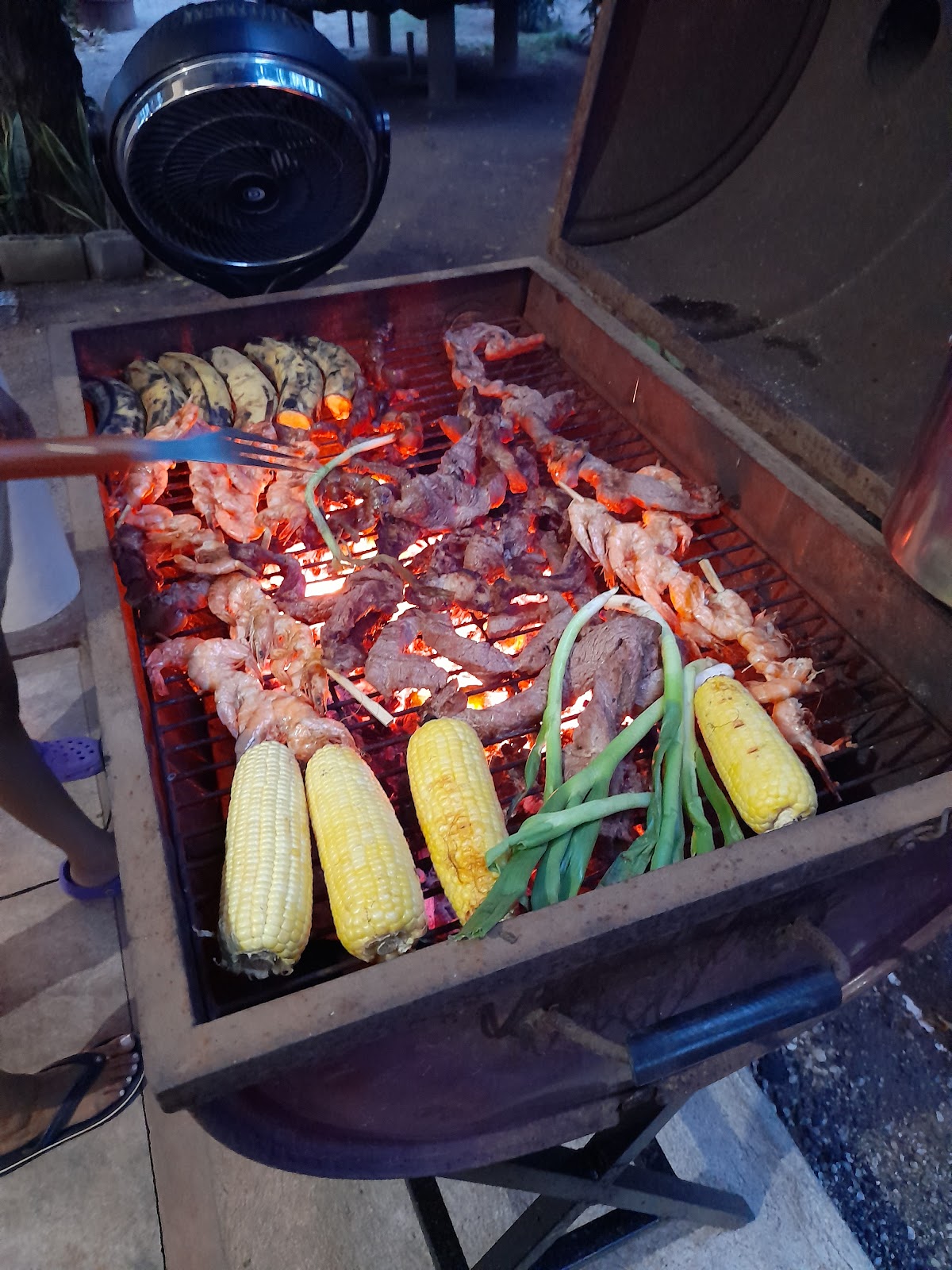
                                                                     Below is a bar-be-que dinner.


                Nely, Gustavo's wife, stands behind their live-in maid, Marta. 

While the parents were away at work, I tuned into local TV programs, where fast-food ads often appeared in the background or at the bottom of the screen during news broadcasts. The country’s economic growth was reported to have stalled. I learned that the euro had fallen almost to a par with the dollar. Ex-President Porfirio Lobo came on-screen thanking the US government for trying to help find the murderers of his son, an American citizen, shot and killed along with 3 others by MS-13 suspects while exiting a Teguc nightclub. Gustavo opined that the new president Xiomara, whose inauguration Kamala Harris had attended earlier in the year, has less control of the gangs than did disgraced former president Juan Orlando Hernández, now in US custody on drug charges, whose brother is already serving time in the US. 

When leaving the house, facemasks were required at all times, even when entering restaurants, though not while actually eating, of course. I noticed the young son was not belted in on short drives. When I questioned this, I was told that on longer drives, he uses a seatbelt with a special car seat. One evening, I went out with Gustavo to pick up a prescription. The pharmacy and its adjacent stores were all lit up, powered by a generator, but nearby court offices and other buildings were all plunged into pitch darkness.

I finally caught up with Art in El Triunfo, my first Peace Corps site, at the local health center, after first making a modest donation in Honduran currency to a woman living across the road. She had lost her daughter to spina bifida back when I’d lived there in 2000-2002. At that time, I’d helped the daughter obtain a wheelchair and water mattress, but she still developed a pressure sore that led to her death. Both spina bifida and cleft palate/harelip have become less common now that pregnant Honduran women are being given folic acid by local health centers, since the corn tortillas that are a dietary staple don’t contain folic acid, mostly found in wheat flour and some other grains. The sign says "Welcome, Barbara".


Everyone at the Triunfo health center greeted me effusively with hugs. I left some Rx meds there, along with toys, sterile bandages, and extra clothing for child and adult patients. 


Here above is Doctora Jeanette at the health center with a patient before her recent retirement. Below, she stands in the town square. 

                                         
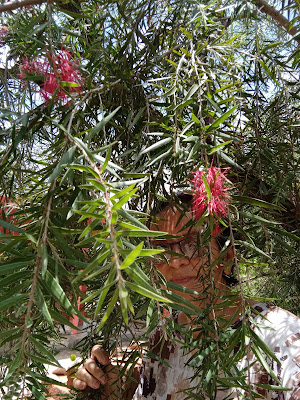
                                               Again below, Jeanette peers out from foliage.


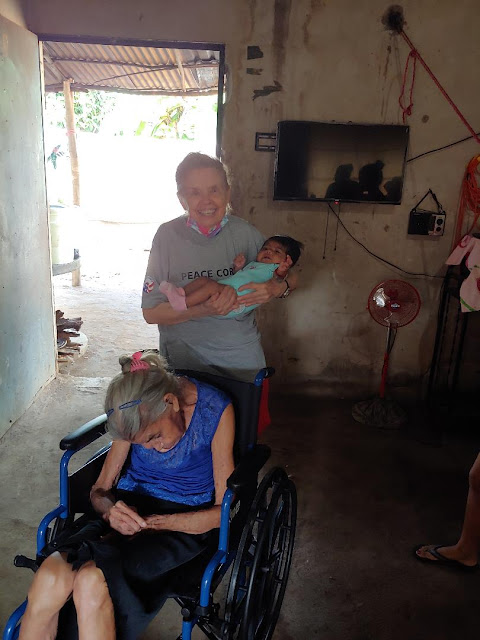
Then Art and I went with Dra. Jeanette, now retired, to take the wheelchair I'd brought to a lady who had suffered a stroke. The woman lives with her extended family in a tiny house (2 rooms), but now will be able to go outside and travel around town. I've already heard from Jeanette that the family has been taking her out and about.



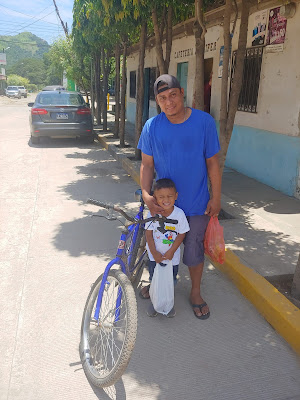


                            Below is Art with a family he has befriended in El Triunfo.

                           
                                    Here below are more of Art's friends in El Triunfo. 


                               Art and I take a break and then I visit with an old friend below. 


Elsewhere, soup is cooking and, below that, more pots hang at the ready.


I also distributed some clothes, toys, medications, and other items from a suitcase that had been checked with the airline and gave the suitcase itself to musician and welder Pedro Joaquín, who, along with his boys, entertained us with music and song. I well remember when his twin daughters, now college age, were born. I had given his wife calcium tablets from my own Peace Corps medical kit as she was then nursing a baby on each breast. Now the girls, looking tall and heathy, attend classes in Choluteca, traveling there by bus.

The family had just moved to a vacant lot near the former family home and were in the process of constructing a new 2-story residence with their own labor. Pedro Joaquín said they had completely abandoned the old house; just walked away. This new one will have a flush toilet rather than the outdoor latrine at the old house. But the new house was still a work-in-progress. I sat with the family on the stairs of their brand new 2-story home.


 Pedro J. is also a musician who, with his sons, plays at gigs in town and surrounding communities.


                                  One son, above, plays drums. Another below plays sax. 


In El Triunfo, in the Peace Corps in 2000-2002, I had befriended a little girl named Neris, appearing with me on the lower righthand corner of my Honduras book, Triumph & Hope. She now has 3 children and spells her name Nerys. Below is my photo with her back then and below that, she appears caring for her baby brother, a task that often fell to young girls then (and maybe still does).


Art and his traveling companion helped me track down Nerys now, as she was not at home. We found her attending a day-long evangelical meeting with her youngest child.


                           Below is a still from Art's video of cattle moving past us on the road. 


After making other rounds in town, we returned to Choluteca, where I had invited everyone out to dinner at a restaurant. We were only allowed to remove our masks while actually eating. Masking requirements are very strict in Honduras. 


Above is my only photo of Gustavo, in glasses, at the restaurant with his mask off, and with his young son on the right. Below, I face a huge order that others helped me eat. Later, we brought food home to Marta, who does not socialize with the family outside the home.


Art and his companion needed to return to San Pedo Sula, but I stayed on, twice visiting Reina, formerly of El Triunfo, who now lives in Choluteca after undergoing a stroke. At one of my visits, her 5-year-old granddaughter was there and I gave her some books, and also gave Reina some Honduran cash. The little girl was born in California, which may prove advantageous later in life. I was never able to see her mother, Solei, one of the secret twins depicted in my book Triumph & Hope.


Finally, I visited the Castro family who sell fried chicken, other foods, and also bottled water every day of the year, even on Christmas, at their market stall. 


                                                              Below I am at the family shop.


Photos were also taken at the Castros' home in Choluteca, but I only received them much later by way of their sister, Lesly, now living in NH with her former Peace Corps volunteer husband, Sam, and their 2 daughters. Lesly, a doctor with whom I'd worked at the Triunfo health center when I was a Peace Corps volunteer, now works in the US as a nurse practitioner, speaking Spanish with Spanish-speaking patients. She visited her family in Honduras last December with her younger daughter. I always stayed with her very
 hospitable family during my post-Peace Corps humanitarian visits, often sharing a bed, until Gustavo built his house and invited me there. 


Tuesday, August 9, 2022

Interim Posting, Honduras Trip Narrative Will Follow

Since I did not take a camera with me to Honduras this time, I’m still waiting for photos to come in before posting a report of my trip. Meanwhile, the following is from a neighborhood website, posted before my trip to Honduras, for items probably still needed:

Busloads of migrants have arrived at Union station with nothing but the clothes on their backs and perhaps what they can carry in a backpack. They are in need of basically everything. Following is a list of items most needed which can be dropped off in the Shalom Room at the Church of the Reformation (212 E Capitol, call first) or on any Sunday at the Church of the Brethren at the corner of 4th & N. Carolina from 7am-8PM. Men’s underwear and socks, mainly small and medium sizes (prefer new to ‘gently-used’); same for women, plus bras, footwear, shoes, and socks (some have walked miles in flip-flops). Shirts, trousers, dresses, and other apparel for adults (again, small and medium sizes). Shirts, shorts, pants, underwear, and socks for babies and children of all ages. Backpacks and duffle bags. Travel size toiletry items, menstrual sanitary items, diapers, and baby wipes. Powdered infant cereal, baby formula, and toddler snacks and pouches.

An old friend, “old” in terms of how long I’ve known him and also his chronological age (even more than my own), sent me a poem in Spanish dedicated to me called A BÁRBARA (“To Barbara”).   

After my return from Honduras, I was surprised at how many “erectile disfunction” ads showed up in my Yahoo feed. Advertisers must spew those out willy-nilly, hoping one lands on a receptive consumer.

Just when employers need more workers, Americans are becoming less open to increased immigration.

Daily Mail, Americans' views harden AGAINST immigration -10% more in U.S. want to cut people flows
https://www.dailymail.co.uk/news/article-11091819/Americans-views-harden-AGAINST-immigration-10-U-S-want-cut-people-flows.html

NY Times, After Indiana Mall Shooting, One Hero but No Lasting Solution A loosening of gun restrictions like the Indiana law, passed this year...allowed the bystander, Elisjsha Dicken, 22, to carry his 9-mm handgun in the first place. Proponents of expanded gun rights were quick to praise Dicken’s actions. “We will say it again: The only way to stop a bad guy with a gun is a good guy with a gun,” the National Rifle Association wrote in a tweet Monday morning.

But Dicken’s act, though heroic, was also a statistical unicorn. An examination of 433 active shooter attacks in the United States between 2000 and 2021 showed that only 22 ended with a bystander shooting an attacker, according to data from the Advanced Law Enforcement Rapid Response Training Center at Texas State University. In 10 of those cases, the armed bystander was a security guard or off-duty law enforcement officer. In other encounters, civilians attempting to step in and stop an assailant were themselves shot to death by police.

“It is exceedingly rare, the exception rather than the rule,” Adam Skaggs, chief counsel and policy director at the Giffords Law Center to Prevent Gun Violence, said... “The reality is that more people carrying guns means more conflicts escalating into deadly violence and more people being shot and killed.”  (The assailant here was, like many such shooters, a 20-year-old man.)

Wash. Post, As Haiti sinks into pandemonium, the international community is silent

Telegraph, Trans prisoners ‘will not be housed with other women’

In both US and UK, trans prisoners who self-identify as female but still possess male genitalia have often been found to have raped or impregnated female prisoners. Is their self-identification as trans merely a ploy by some to have sexual access to female inmates? At least in the UK, now they will be housed separately from both other female and male inmates.

Many folks now consider it a right to be able to have sex with whomever they want whenever the fancy strikes with no consequences. An effective vaccine strategy for Monkeypox is still under review. 

No consequences for sex also apply to pregnancy risk.

NYTimes, Some Students Want Colleges to Provide the Abortion Pill. Schools Are ResistingMany colleges pride themselves on providing a range of sexual and reproductive health services for their students, including birth control, screenings for sexually transmitted diseases and even insurance coverage to terminate a pregnancy. What they do not tend to provide is abortion, either by pill or through a procedure. For that, they refer students to other clinics or doctors’ offices.

Women can now take the morning-after pill and, if they become pregnant, then take at-home abortifacients. Does the abortion pill make young women more careless about having sex knowing they can reverse a pregnancy, should that be the outcome?

Where does contraception end and abortion begin?

Red states are now making their own adjustments.

NY Times, Georgia Abortion Law Says a Fetus Is Tax Deductible


Wash. Post, Post Roe, some in GOP wage uphill battle to offer families more support

Quite obviously, it costs much more to raise a child to adulthood than to provide an abortion. Every person now on earth began as a baby (and, before that, as a fetus). Those early years can tough for young families, especially for single mothers, so any assistance would be helpful. However, once that child has grown up, he or she can become a contributor to society and to the economy. Bravo to those Republicans who now recognize this universal timeline, but not enough of them are getting behind the effort to help out in the early years.

Even after the Supreme Court struck down Roe vs. Wade, anti-abortion demonstrations have continued.


Tuesday, July 12, 2022

Gun Owners Licenses? Latin America, More Help for Mothers


I wasn’t planning on making another blog posting before my Honduras trip, but here is one after all. Trying not to be too fussy this time, as long as the posting is understandable,. 


My daughter Melanie found these items from the past posted on Facebook. My late son Andrew as a boy appears there. 


That's a gathering on the front porch of the house I still live in now. Son Andrew is on the right, chin on hand. Daughter Stephanie's face appears near the bottom and Jonathan is behind her, his head thrown back. Those were fun, innocent days. 


This looks like a clipping from an even earlier time, August '78 with Andrew second from the top right before his 11th birthday. I don't know who posted these, but I'm glad to see them. 

Friends in Mexico City sent me belated July 4th greetings with this photo of 
women there wearing red, white, blue.  


Why not require a test and a license to buy or own a gun? One is required for driving a car and must be renewed periodically. Also, the age for gun ownership definitely needs to be raised to 21 to reduce the chances of young men at their most volatile age, when testosterone first surges, of getting their hands on a firearm. But Shinzo Abe’s killer in Japan was 41 and is an example of someone who was so hell-bent on shooting someone, that he even went to the lengths of fashioning his own gun. Hondurans also do it all the time.


NYTimes, Assassination Shocks a Nearly Gun-Free Japan The assassination of former Prime Minister Shinzo Abe during a campaign rally in western Japan was especially hard to fathom because it involved a gun — a type of crime that is extremely rare in a country with some of the most stringent laws on buying and owning firearms. Gun violence is almost unheard-of in Japan. There was only one firearm-related death in all of 2021. Since 2017, there have been 14 gun-related deaths, a remarkably low figure for a country of 125 million people.


Fox, VP Harris calls for 'assault weapons ban' on guns 'intentionally designed to kill' people Vice President Kamala Harris on Sunday called for the reinstatement of the Federal Assault Weapons Ban, arguing that certain semi-automatic firearms are "intentionally designed" to kill people and only belong on the battlefield.


NY Times, After Another Mass Shooting, Questions Loom About the Role of Parents Most mass shooters are young men between 18 and 21, many still living at home with parents. The 21-year-old Highland Park shooter’s parents had had considerable trouble with him for years before, yet his father sponsored him for a firearms license.


Milwaukee Journal Sentinel, What keeps an ER doctor up at night: 'The sound a mother makes after her child dies.' I am a pediatric emergency physician in a poor, segregated city in America, and I am calling attention to the No. 1 killer of children: guns. 


Slightly more than half of gun deaths in the US are suicides. Our country has the highest gun suicide rate in the world. Most homicides in the US are also committed with guns, with most victims being women. There were 45,000 gun deaths in the US in 2021, including 22 school shootings carried out with guns. Yet, 21 states allow concealed-carry without a license.   


Wash. Post, There are too many mass shootings for the U.S. media to cover

The Wrap, Trump Calls Elon Musk a “Bulls– Artist,” Internet Dies Laughing Talk about the kettle calling the pot black!

Go home’: Honduran islanders fight against crypto colonialists.

https://www.theguardian.com/world/2022/jul/05/honduras-land-rights-fight-crypto-colonialists?CMP=share_btn_link


BBC News, Nicaragua expels Mother Teresa's nuns in latest crackdown


AP, Nicaragua goes after newspaper for reporting nuns' expulsion


In 1990, I suddenly came upon Mother Teresa wearing white robes praying at a remote religious shrine in Nicaragua. She was tiny. A man in civilian clothes stood quietly behind her. A vehicle was parked nearby. The shrine was deep in the jungle at the end of an unpaved road—really just a trail--so my Nicaraguan friend Larry (now deceased) and I were surprised to encounter anyone else there. Larry had driven us there in a bouncy homemade 3-wheeled contraption he called the boogy-boogy to show me that secret sacred spot. We nodded to Mother Teresa and her companion, then knelt down ourselves. Now I see that her nuns are being ejected from Nicaragua by the very same Daniel Ortega who had lost that 1990 election, the election which I had come to Nicaragua to help monitor then.


Miami Herald, The killing of a Black youth in Cuba sparks criticism of police brutality and racism Since 2020, human rights activists have documented at least four extrajudicial killings of young Black men by police, including that of Diubis Laurencio Tejeda, killed by a police officer during the July 11 protests last year.


Wash. Post, How Cuba’s investment in writers and artists came back to haunt its regime In Cuba, hundreds of innocent people are in prison because they dared to demand freedom. Exiles are still fighting from abroad.


Wash. Post, Last year, Cubans took to the streets. Now they’re fleeing the island

Daily Telegram (Mich.), Dobbs case: An unborn human being but not a person


AP, Federal judge blocks Arizona's 'personhood' abortion law

Courier Journal, 'It wouldn’t be my choice for judge': Senate Democrats slam Biden planned anti-abortion pick


Wall St. Journal, The White House clarified new federal guidance around abortion: Hospitals must provide the procedure in emergency situations, regardless of state law.


Not only are guns now killing more American children than auto accidents, but too few children are actually being born both in the US and other developed countries. A baby bust is skewing national demographics, making the population here in the US top heavy with baby boomers and elders like me. President Biden is trying to offer more economic help to families with young kids. As said before, for population size and age distribution to remain steady and optimal, women must produce an average of 2.1 children, something not happening now. Pro-life folks need get behind efforts to increase public support for young families, which most of them don’t seem to be doing so far, relying instead on small private or church-related programs that can help only a small number of pregnant women for a limited time. Raising a child to adulthood is a long-haul proposition and many single mothers need more sustained assistance. I was a single mother myself, so I know hard that is, though at least I was college educated and was able to hold a fairly well-paying job. Pro-lifers need to advocate for more help for mothers after a child is born, but most don’t seem to be doing that. That failure needs to remedied as part of a more practical and targeted approach


As both a birth and an adoptive mother, I’d also like to hear pro-life folks make more cogent humanitarian non-religious arguments for their position, especially when aiming at those wavering in the middle like myself. By and large, they have not been doing that so far. But they and pro-choice folks have both been seen almost daily on our streets. 

Mainstream media seem to be firmly on the side of supporting unfettered access to abortion, but often use slanted terms like “pro-choice rights” or “constitutionally guaranteed reproductive care.” Some pundits are also trying to make the case that pro-life policies are “racist” since proportionately more black women seek abortions. To the contrary, the racist label might be applied more aptly to abortion itself, which disproportionately affects black unborn babies. OTC birth control available soon in some places should help, as preventing an unwanted pregnancy is preferable to trying to end it.

Some counter pressures to abortion are developing within the broader society of which women of childbearing age are a part. More is now known about fetal development than when Roe was decided, and fathers are asserting more rights, especially gay fathers who want to become custodial parents. Preemie infants now born earlier can survive, indicating, at the very least, that the abortion timetable should be moved back.  

If more help for new mothers, as proposed by the Biden administration, actually comes about, a reversal of the current “baby bust” may follow. The ideal from a national perspective would be to keep the US average birthrate at about 2.1 per woman of childbearing age, that is, at just over replacement. Presently, our average birthrate is substantially below that, only at 1.6 children per woman. Often, mothers with young children now stop at 2 and many other women stop at one or none. US birth rates have been declining since 2007, though with a slight uptick so far this year. In Europe and Japan, the overall aging of the population is even more dire. China is belatedly providing incentives to reverse its one-child policy, but is now reproducing at about the same rate as the US with families there still favoring boys who are not future child bearers. By next year, India is on track to surpass China as the world’s most populous nation. Countries with the highest fertility rates are almost all in Africa, with Niger taking first place with an average of 7 births per woman.

 ///////////////////////////////////


Дмитрий Ишутин

Above is a Facebook friend suggestion


Alien Abductees Group, is another Facebook suggestion

Ofertas de Xfinity Internet

Justicia ClimáticaDESCUBRE LA VIDA QUE S

Envío gratis en 2 días

Obtenlo rápido